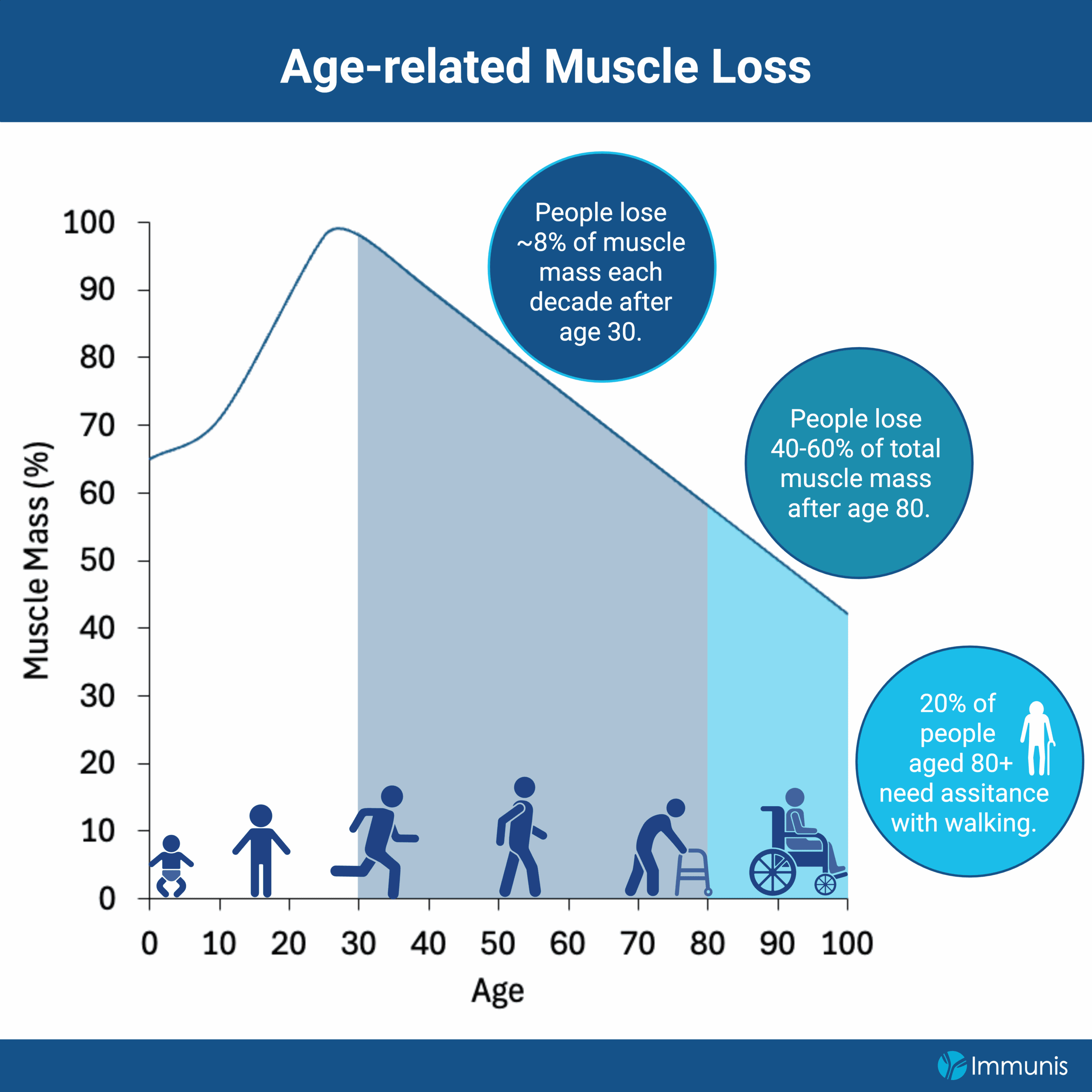
Since the late 1960s, researchers and clinicians have been documenting the gradual changes in muscle morphology with time, noting differences in people depending on their age and sex. Analyses from human biopsies show that muscle loss begins in people around their mid-20s to early 30s. Individuals lose about 3-8% of their total muscle mass each decade after the age of 30, declining to around 60% of maximal muscle mass by age 80.2,3 Sarcopenia becomes more prominent and clinically relevant for people during and after their 80s. In fact, about 50% of people aged 80+ have sarcopenia and 20% need assistance walking.4 A sedentary lifestyle is more common with old age, which increases an individuals’ risk for muscle wasting, therefore, regular activity and exercise is highly recommended to combat sarcopenia.
On average, men have more muscle compared to women, but both demonstrate an age-related decline in muscle fiber size.4 Interestingly, the prevalence of sarcopenia is influenced by the level of physical activity in older women, but not in older men. Female athletes aged 66-85 have greater muscle area and less muscle fat than their non-athletic female counterparts, suggesting the importance of exercise for muscle maintenance and health in older women.3,5 There was no difference in the muscle or fat content between elderly male athletes and their respective age-matched controls, but physical training still had beneficial effects on muscle function.6 Sex-specific hormonal differences may have a role in modulating the muscular adaptation to physical activity in older adults, making the prevalence of sarcopenia more sensitive to physical activity levels in older women than in older men.